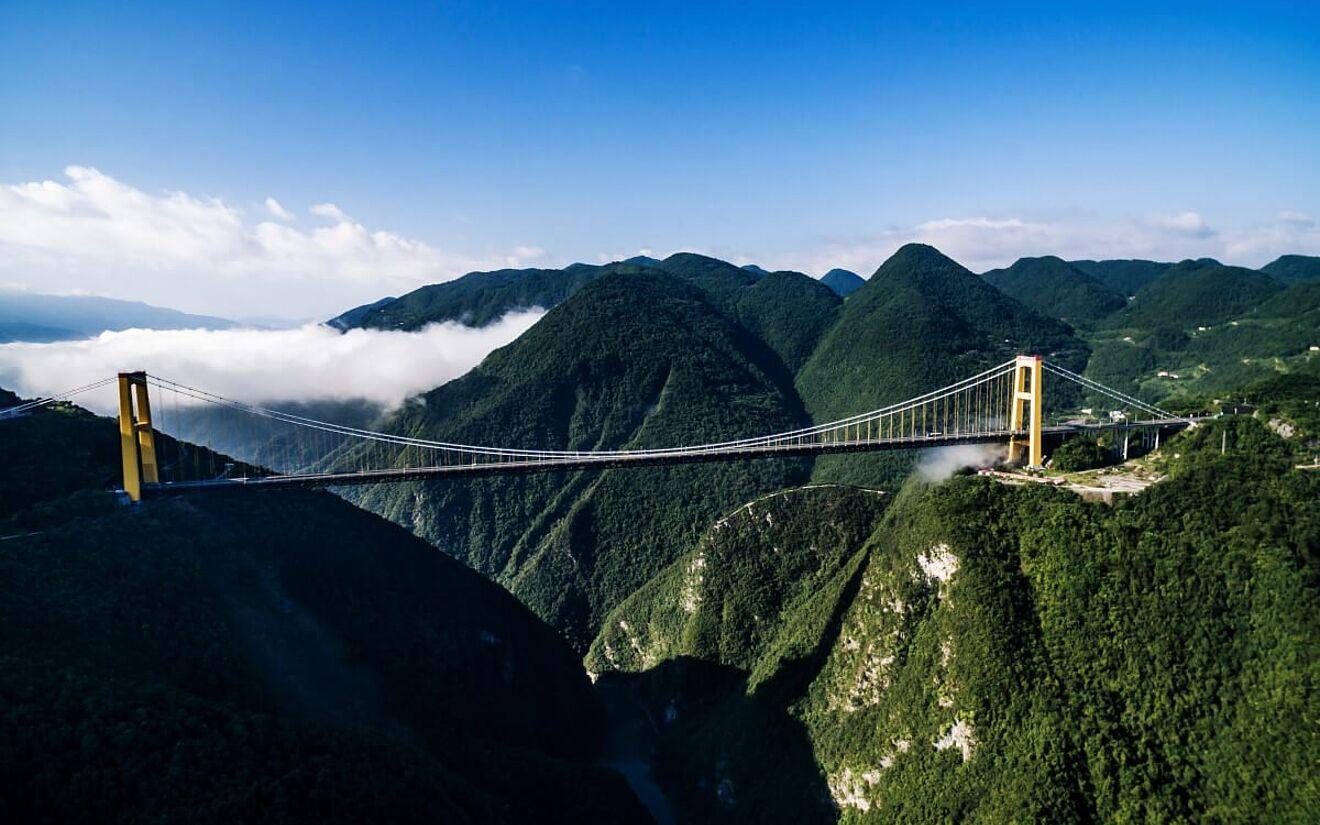
Whether they are 400 or over 600 meters deep, no canyon is too deep for the world's highest bridges. In this list, we show which bridges currently hold the top positions, why they all span Chinese canyons, and what makes these structures so special.
Why are Chinese gorges breaking bridge records
Superlatives in bridge construction rarely happen by accident. They are an expression of technical ambition, national strength – and sometimes a matter of prestige. But even if the desire to set records plays a role, the world's highest bridges usually serve very specific, practical purposes. They overcome huge differences in altitude, connect remote regions, and create traffic links where traditional road construction reaches its limits.
Our quest inevitably leads us to China. Nine of the world's ten tallest bridges are now located there – a ratio that only slightly differs when it comes to the top 100. In fact, China claims all of the top five spots for itself. But why is this the case? In addition to having extremely mountainous regions with deep valleys, the country's targeted expansion policy also plays a key role.
Roads and railways require significantly less space in the form of bridges than in traditional construction – up to 2.9 hectares of land can be saved per kilometer of track. Furthermore, important traffic arteries can be routed through densely built-up regions without relocating buildings or separating neighborhoods from each other. These mostly prefabricated structures allow for rapid construction and easy maintenance.
Therefore, it is no coincidence that the world's highest bridges are built precisely where topography, technology, and planning policy meet.
1st Place: Huajiang Canyon Bridge
As of summer 2025, the Huajiang Canyon Bridge holds the title of ‘world's highest bridge’. Its deck is situated 625 meters above the Beipan River tributary in Guizhou, China. This places it far ahead of the previous record holder.
The bridge has a total length of 2,890 meters, with an impressive main span of 1,420 meters. Two pylons, reaching a height of up to 262 meters, support the central segment of the bridge, which hangs freely between them over the canyon.
This construction is made possible by prefabrication and efficient production methods. The bridge will be open to traffic at the end of June 2025 and marks a new technical milestone in bridge construction. The world's highest bridge thus remains in China – a technical masterpiece pushing the limits of what's possible.
2nd place: Beipanjiang Bridge (Duge Bridge)
At 565 meters above the Beipanjiang River valley, the Beipanjiang Bridge, also known as the Duge Bridge, was considered the highest bridge in the world for many years. Located on the border between the Chinese provinces of Guizhou and Yunnan, it opened to traffic in 2016 as part of the Hangzhou-Ruili Expressway (G56).
The cable-stayed bridge has a total length of 1341 meters. Its main span of 720 meters crosses a valley between two pylons, the eastern of which, about 269 meters high, is one of the tallest in the world. The central part of the bridge deck is designed as an open steel truss structure, enclosed by massive concrete beams at both ends.
Although it has since lost its top spot, the Beipanjiang Bridge remains a milestone in bridge construction—both from a technical standpoint and for its position in one of China's most spectacular mountain valleys. As the second-highest bridge in the world, it is an impressive example of how efficient engineering and topography can work together.
3rd place: Siduhe Bridge
Siduhe Bridge near Yesanguan in China's Hubei Province is one of the pioneering structures in modern bridge construction. Its roadway spans 496 meters above the river – close to the 500-meter mark. When it opened in 2009, it was the highest bridge in the world and held the top spot for seven years.
The suspension bridge is part of the important Shanghai-Chongqing Expressway and spans the narrow Siduhe valley for about 1100 meters. If you include the outer anchor points, it measures a remarkable 1222 meters. Its main span between the pylons is 900 meters – an outstanding dimension that set new standards at the time.
Special attention was drawn to the construction method: the first suspension rope was not pulled with an auxiliary rope as usual, but was instead shot across the gorge with the help of a military rocket – a first in bridge construction. This innovative method was later applied to other projects, such as the Puli Bridge.
4th place: Bridge of Pula
Steep gorges and difficult terrain characterize the region around Pulixiang in Yunnan – here, the Puli Bridge spans the valley of the same name at a height of 485 meters. It was completed in 2015 and is part of the Hangzhou–Ruili Expressway, which forms an important east-west connection in southern China.
The suspension bridge measures a total of 1040 meters, with a main span of 628 meters. Its hybrid construction is particularly striking: between the pylons runs a steel box girder with an aerodynamic profile, which is connected to the suspension cables by double steel rods. The ends of the bridge consist of reinforced concrete slab beams, supported by massive piers.
The Most Puli is one of the most technically sophisticated hybrid constructions in China's high mountains – an example of how building designs can be flexibly adapted to extreme landscape conditions.
5th Place: Jinshajiang-Jin'an Bridge
Since 2020, one of China's most impressive suspension bridges has spanned the Jinsha River – the upper reaches of the Yangtze River – in Yunnan Province. Its official name is Jinshajiang Bridge-Jin’an, but it is commonly referred to simply as the Jin’an Bridge. The road is 461 meters above the valley floor, which currently ranks it as the fifth-highest bridge in the world.
However, it is not guaranteed that this rank will remain unchanged: the bridge spans over the Jinanqiao Dam, whose reservoir can raise the river level up to 126 meters. At maximum water level, the effective height drops to 335 meters and the bridge temporarily falls out of the top 15 highest bridges.
The Most Jin'an is part of the Chengdu-Lijiang Expressway and was built specifically to connect two remote mountainous regions. It is another impressive example of how technical expertise and geographical challenges converge in modern bridge construction.
Why aren't tall bridges just record-breakers
The world's tallest bridges are built where direct connections are needed across uneven terrain. Their height is determined by geographical conditions and the goal of creating efficient, permanent routes without major detours. They enable traffic in regions that have long been difficult to access and shorten distances between previously remote locations. The world's tallest bridges are a testament to the fact that even the most challenging conditions can be transformed into functional infrastructure.
Source: https://www.allplan.com/blog/the-top-5-highest-bridges/
This article was translated and published with permission from the source.